Originally posted 2021-09-17
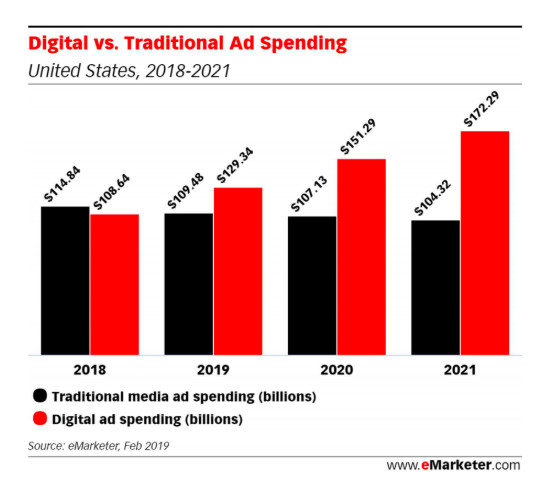
Digital advertising is an amazing business. Every second of the day Google and Facebook are serving ads to their users on behalf of advertisers paying out on every click. The more effectively they convince users to click these ads the more each one sells for. The supply of ads will always exist so long as they have users on their platform. As the shift away from traditional advertising continues, other firms have begun to realize that a piece of this ever-growing market is up for the taking. Microsoft has Bing and Linkedin. Apple has a stranglehold over 1 billion smartphone users–Apple News, the app store–both offer very lucrative advertising channels. Amazon has the largest retail platform in the world with over 200 million paying Prime subscribers and millions of active sellers. Even Walmart has followed Amazon’s lead and is selling ads through their new ‘Walmart Connect’ digital ad marketplace. The market for digital advertising is on track to double that of traditional advertising in the coming years.
Last April Apple made a sweeping change across iOS that required developers to ask for permission to track user activity across apps. For those unaware of our current surveillance capitalist hellscape, let me explain exactly how this has impacted developers on iOS. When you use apps on your iPhone like Instagram or Snapchat, these companies used to be able to sift through all of the data you have created in your time on every single app on your phone. Being able to use this massive trove of data to better serve ads was vitally important for these companies. For example, Yoga studios could serve ads to people who are interested in yoga, who live within a certain area, and have kids. Only having the user data that your app generates makes for ads that are less specific to each user and therefore less appealing to advertisers. Companies like Facebook have a wealth of data about you from their own app they still miss out on significant targeting information due to the lack of access to cross-app tracking.
Amazon
Amazon is mainly thought of in the context of their retail operation and AWS they have been silently building a solid advertising business on the side designated under “Other”. This business rose 87% y/y to $6.9 Billion in revenue. Which is a relatively small number considering Amazon is a company with yearly TTM revenue of $443 Billion. This advertising business is extremely scalable though. Amazon has a platform of 200 Million Prime users, and years of data on them to boot, as well as the millions of daily viewers on their video game streaming platform, Twitch.
Amazon has such a unique opportunity when it comes to monetizing the attention of its users. Everything inside of Amazon’s ecosystem is monetizable through digital advertising. The company is spending more and more to acquire broadcast rights including paying $1 Billion per year for exclusive rights to Thursday night football between 2022 and 2033. The company just acquired MGM for $8 Billion and is in talks to acquire NFL Sunday Ticket from Directv. If both of these deals go through it will give Amazon’s platforms even more eyeballs than before. Every deal they make will dwindle down their near $90 Billion cash stack, but it will more than makeup for it in viewership. Other media outfits like Disney, Warnermedia, and Viacom are not able to cut these massive checks as they only have a fraction of Amazon’s cash, but they also have commitments to their own content flywheels.
Microsoft
In early 2021 Microsoft held talks with social media firm Pinterest about an acquisition priced at $51 Billion. That represents only a minute percentage of Microsoft’s market capitalization, but it tells us what Satya Nadella and Co. think about the digital advertising space. Although it would have been a boon largely just to get Pinterest to move from AWS to Azure it is also a meaningful vote of confidence for Pinterest’s business model and digital advertising in general. M&A talks like this show that big-time industry players see the industry continuing to grow well into the future.
It is also worth mentioning that Microsoft’s largest acquisition ever is Linkedin. In 2016 the company spent around $26 Billion to acquire the professional social networking site. Linkedin’s revenue is only partially attributed to advertising (around 20%) it is still worthwhile to note that the company was a very attractive acquisition target due to its treasure trove of data on millions of working professionals.
Microsoft may not be purely monetizing this user data with advertising right away, but it will surely help them in their new push towards creating a more social-friendly operating system. Microsoft Start will be packaged with Windows 11 and Linkedin’s user data will absolutely be used to cultivate advertisements to windows users.
Apple
Apple has been praised over the last few years for its fidelity to its users’ privacy. The firm has done some remarkable things to protect the privacy of its users. Despite that, it has been slowly building a digital advertising business that continues to bolster revenues in its services segment. The fact that Apple can simultaneously hit its competition by not allowing cross-app tracking, but also build its own multi-billion dollar advertising business says all you need to know about their customer base. People are so completely locked into the Apple “walled garden” that apple can criticize others for making their money through advertising, yet at the same time build a business serving ads to the same people whose data they were trying to “protect” with the iOS cross-app tracking update.
Evercore ISI analyst Amit Daryanani has projected that Apple’s advertising revenue will rise from $2 billion this year to $20 Billion in 2025. At this rate by 2025 advertising would account for 17% of services revenue and around 5% of total revenue to the firm. The high margin profile of the business would also add $.50 per share EPS contribution according to Daryanani. Even if these projections seem a bit rosy, I would argue that even if the numbers are a bit high it illustrates Apple’s ability to continually pull levers to grow their business. There are now over 1 billion iPhone users worldwide. The kind of people who are willing to pay the Apple premium for these devices are the exact kind of people advertisers want access to; evidenced by the hit Facebook took in response to not being able to track iPhone users across apps. Over the next decade, as services become a larger and larger part of Apple’s revenue base be sure to watch out for exactly what is driving this growth; I predict Apple’s advertising growth to outpace the rest of the speedy growth already seen in other pieces of the services segment.
Other playersIt is also worth mentioning that there are players outside of the ultra mega-cap tech names that are chipping away at the Google/Facebook digital advertising duopoly. Walmart has been building out ‘Walmart Connect’ an advertising business that is up 95% over a year ago this past quarter. Not to mention the growth of 170% in active advertisers on the platform.
Smaller social media firms like Snapchat and Pinterest are progressively improving their appeal to advertisers, evidenced by their rapidly growing ARPU numbers. Snap has grown ARPU from $1.91 in Q2 2020 to 3.35 in Q2 2021, representing an increase of more than 75% in one year. Advertisers are noticing the power in their platform and have continued to contribute more advertising dollars to it.
Conclusion
As of right now Google and Facebook are as close to a true duopoly as you can be in digital advertising. As this decade presses on I am certain their market-share will get compressed, but also digital ad budgets will continue to grow alongside that. As competition heats up in the space keep your eyes out for who is growing revenue on their ad platform the quickest, but also who is keeping advertisers the happiest. The number of users a product attracts is a hot commodity to be sure, but the real customer is the advertiser. If they are happy the company will be happy.

 Trying to Understand